25 October 2005
Cantrina a mini Burgundy - Giornale di Brescia
Cantrina a mini Burgundy
The winery founded by Dario Battoli and run by his widow Cristina Inganni
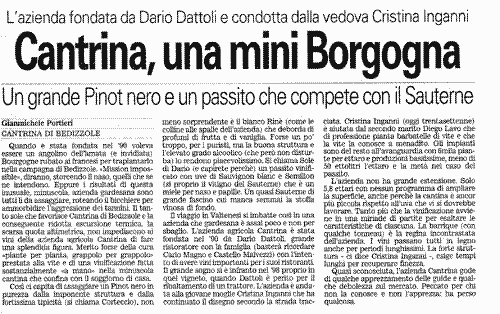
The Giornale di Brescia in an article describes Azienda Agricola Cantrina, here are the highlights:
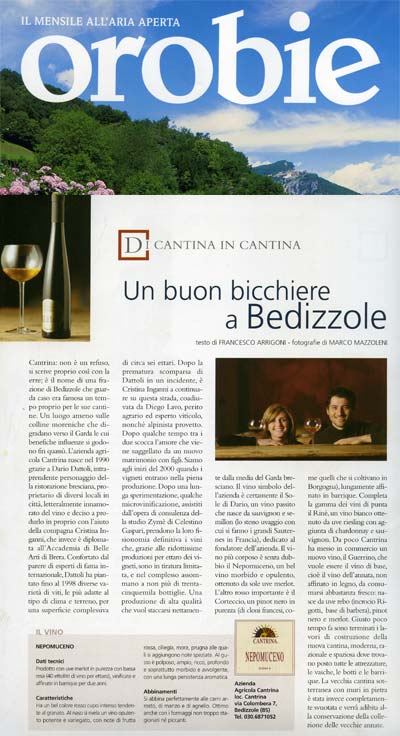
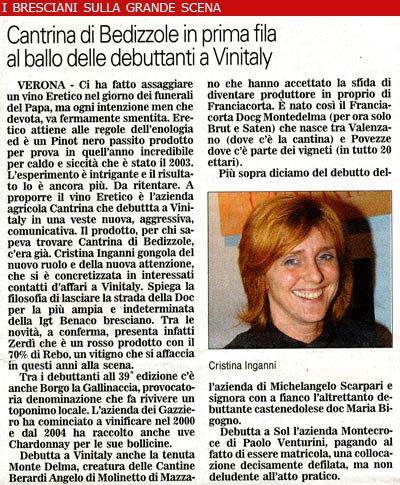
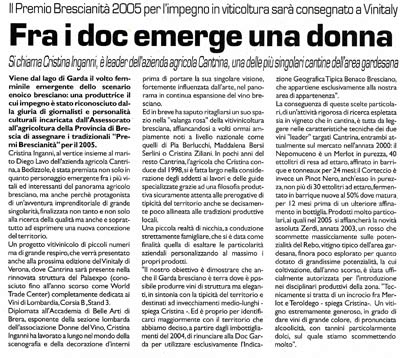
(...) When it was founded in the 1990s it wanted to be a little corner of the beloved (and envied) Bourgogne stolen from the French and transplanted to the Bedizzole countryside. ’Mission impossible«, those in the know will say, wrinkling their noses. And yet the results of this unusual, tiny Garda winery are all there to be tasted, swirling the glass to soften the aggression of the tannins. The plenty of sunshine that favours Cantrina di Bedizzole and the consequent narrow temperature range, the low altitude, do not prevent the wines of the Cantrina winery from making a splendid impression. Merit perhaps goes to the »plant by plant, bunch by bunch« care given to the vines and to winemaking done essentially »by hand« in the tiny cellar that borders the living room of the house. Thus we happen to taste a Pinot Noir in purity with an imposing structure and very typical character (it is called Corteccio), no less surprising is the white Riné (like the hills behind the winery) that overflows with scents of fruit and vanilla. Perhaps a little too much, for purists, but the good structure and high alcohol content (which, however, does not disturb) make it very pleasant. It is called Sole di Dario (and you will understand why) a passito vinified with Sauvignon blanc and Semillon grapes (yes, the Sauterne variety) that is a honey for nose and taste buds. An almost Sauterne of great charm that, if anything, lacks the underlying vinous quality. The journey to Valtènesi thus comes across a winery that is very little Garda, and not by accident. The Cantrina winery was founded in the 1990s by Dario Dattoli, a great restaurateur with his family (just remember Carlo Magno and Castello Malvezzi) with the intention of having important wines for his restaurants. The great dream was shattered in »98 in that very vineyard, when Dattoli perished when a tractor overturned. The company went to his young wife Cristina Inganni, who has continued the design along the path Cristina Inganni (now aged 37) is helped by her second husband Diego Lavo, who plants vine shoots by profession and knows vines inside out. The plantings are state-of-the-art with 6,000 vines per hectare and very low production, less than 50 hectolitres per hectare and half in the case of the passito. The estate does not have a large extension. Only 5.8 hectares with no plans to expand the surface area, also because the winery is even smaller than the grapes that should be processed there. All the more so because vinification takes place in a myriad of batches to enhance the characteristics of each. The barrique (with a few tonneaux) is the undisputed queen of the winery. The wines all spend very long periods in wood. The strong structure, Cristina Inganni tells us, requires a long time to recover finesse. Almost unknown, the Cantrina winery enjoys some appreciation from the guides and some weakness on the market. Too bad for those who do not know it and do not appreciate it: they have lost something. (...)