14 June 2005
Cantrina, target doubling - Brescia Oggi
Bresciaoggi describes in an article the new winery of Azienda Agricola Cantrina, here are the highlights:
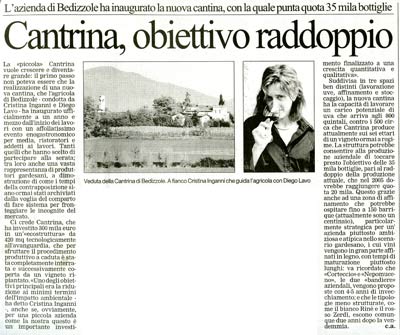
Cantrina, goal doubled.
(...) The «little» Cantrina wants to grow and become big: the first step could only be the construction of a new winery, which the Bedizzole-based farm - run by Cristina Inganni and Diego Lavo - officially inaugurated a year and a half after work began with a packed food and wine event for the media, restaurateurs and those in the trade. (...)
(...) Cantrina believes in this, having invested 300,000 euro in a technologically advanced 420 square metre ’ecostructure«, which, in order to take advantage of the drop production process, was completely buried and subsequently covered by a replanted vineyard. »One of the main objectives was to reduce the environmental impact to a minimum,« said Cristina Inganni, »although, obviously, for a small company like ours this is an important investment aimed at quantitative and qualitative growth. Divided into three distinct areas (grape processing, ageing and storage), the new cellar has the capacity to process a potential load of grapes of up to 800 quintals, compared to the 500 or so that Cantrina currently produces on the six hectares of a vineyard that is now fully operational. The facility could enable the company's production to soon reach the target of 35 thousand bottles, which would double the current production, which is expected to reach 20 thousand in 2005. This is also thanks to an ageing area that could house up to 150 barriques (there are currently a hundred or so), which is particularly strategic for a rather ambitious and atypical company in the Garda scenario, whose wines are for the most part aged in wood, with rather long maturation times: it should be remembered that «Corteccio» and «Nepomuceno», the company's two «flagships», are proposed with 4-5 years of ageing; and that the less structured types, such as the white Riné and the red Zerdi, are in any case released two years after the harvest. (...)