line

press

the world talks about us

12 April 2005

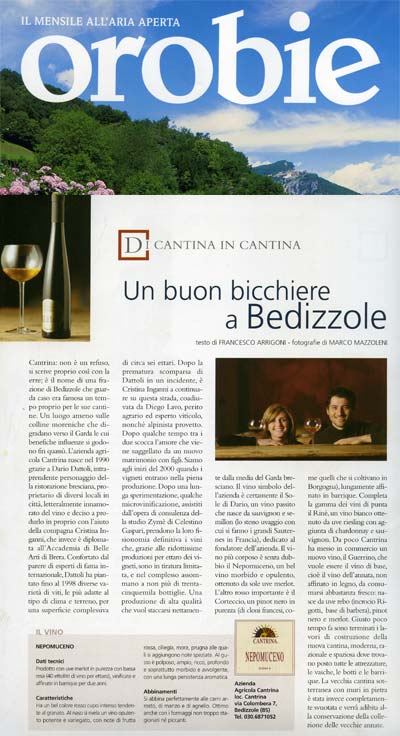
A good glass in Bedizzole - Orobie

The monthly magazine Orobie dedicates an article to Azienda Agricola Cantrina, here are the most significant points: A good glass in Bedizzole (...) Cantrina: this is not a misprint, it is spelt just like that with an 'r'; it is the name of a hamlet of Bedizzole that, as chance would have it, was once famous precisely for its wine cellars. A pleasant place on the morainic hills sloping down towards Lake Garda, whose beneficial influences can be enjoyed right up here. The Cantrina winery was founded in 1990 thanks to Dario Dattoli, an enterprising character in the Brescian restaurant industry, owner of several establishments in the city, who literally fell in love with wine and decided to produce it himself with the help of his partner Cristina Inganni, who on the other hand graduated from the Brera Academy of Fine Arts. Supported by the advice of internationally renowned experts, Dattoli planted different varieties of vines, the most suitable for the type of climate and soil, on a total area of around six hectares until 1998. After Dattoli's untimely death in an accident, it was Cristina Inganni who continued along this path, assisted by Diego Lavo, an agricultural expert and wine expert, as well as an experienced mountaineer. (...) (...) After a long period of experimentation, some microvinification, assisted by the consultancy work of Celestino Gaspari's Zymè studio, the wines take their final shape. Thanks to the very low yields per hectare of the vineyards, they are in limited production, and in total amount to no more than thirty-five thousand bottles. This is a high quality production that is intended to stand out clearly from the average Brescian Carda. The company's flagship wine is certainly Sole di Dario, a passito wine made from Sauvignon and Semillon (the same blend used to make the great Sauternes in France), dedicated to the company's founder. The most full-bodied wine is undoubtedly Nepomuceno, a beautiful, soft and opulent wine made only from merlot grapes. The other important red is Corteccio, a pure Pinot Noir (from French clones, like those grown in Burgundy), aged for a long time in barriques. Completing the range of top wines is Riné, a white wine made from riesling grapes with the addition of chardonnay and sauvignon. Cantrina has recently released a new wine, Guerrino, which is intended to be the base wine, i.e. the wine of the year, not aged in wood, to be consumed fairly fresh: it is made from rebo grapes (Rigotti crossbreed, barbera base), pinot noir and merlot. Just recently, construction work was completed on the new, modern, rational and spacious cellar where all the equipment, tanks, barrels and barriques are located. The old underground cellar with stone walls, on the other hand, has been completely emptied and will be used to store the collection of old vintages.

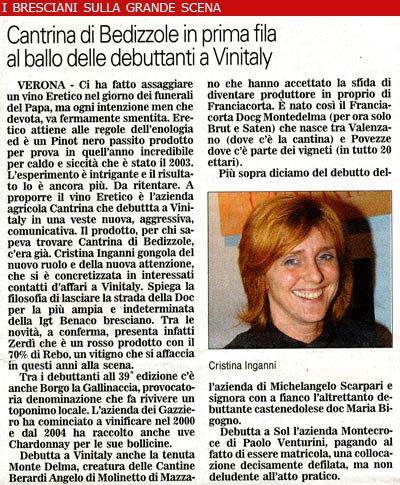
Cantrina di Bedizzole in the front row at the debutante ball at Vinitaly - Giornale di Brescia

posted on 9 April 2005
(...) He made us taste a wine called Eretico on the day of the Pope's funeral, but any less than pious intention must be firmly denied. Eretico adheres to the rules of oenology and is a Pinot Noir passito produced as a trial in that incredible year for heat and drought that was 2003. The experiment is intriguing and the result even more so. To be tried again. Proposing the Eretico wine is the Cantrina winery, which is making its debut at Vinitaly in a new, aggressive, communicative guise. The product, for those who could find Cantrina di Bedizzole, was already there. Cristina Inganni gloats about her new role and the new attention, which took the form of interested business contacts at Vinitaly. (...)

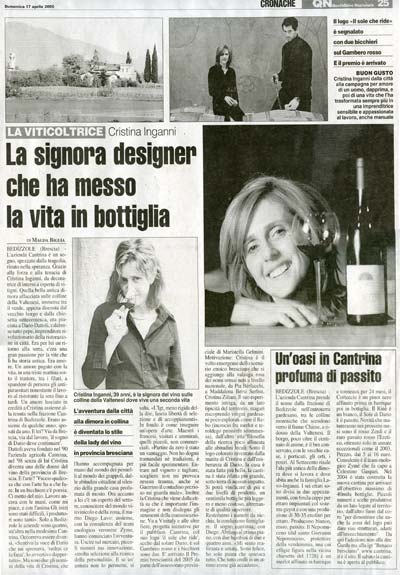
A woman emerges among the docs - Area Blu

posted on 7 April 2005
Her name is Cristina Inganni and she is the leader of the Cantrina winery, one of the most unique wineries in the Garda area. (...) From Lake Garda comes the emerging female face of the Brescia wine scene: a producer whose commitment has been recognised by the jury of journalists and cultural personalities appointed by the Brescia Province Agriculture Department to award the traditional “Brescianity Awards” for 2005. Cristina Inganni, at the helm together with her husband Diego Lavo of the Cantrina farm in Bedizzole. She has been awarded not only as one of the most vital and interesting emerging personalities on the Brescia agricultural scene, but also because she is the protagonist of a highly singular entrepreneurial adventure, aimed not so much and not only at the pursuit of quality, but also and above all at expressing a new conception of the territory.

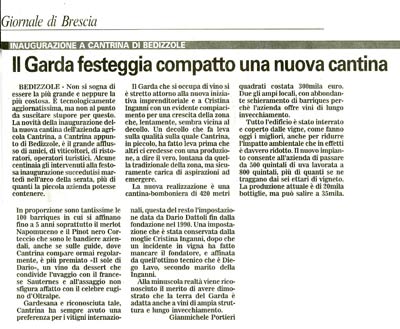
Cantrina: outpost of tradition - Brescia Oggi

posted on 16 February 2005
Agricola Cantrina is the small outpost of Cristina Inganni and Diego Lavo, a woman of wine with a natural inclination towards art, who has decided to bet on a production policy made up of small numbers, great qualitative ambitions, and particularly significant choices such as that of renouncing, starting with the bottling of the 2004 production, the Garda DOC in favour of the Benaco Bresciano Typical Geographical Indication. «It is a decision that stems from the desire to link our production in depth to the territory, betting on a denomination that is the exclusive property of the area," explains Cristina, summarising the philosophy of a company that has always been reluctant to follow the traditional production guidelines of the area. Founded in 1990 by Dario Dattoli, a well-known Brescian restaurateur and winemaker by passion, the winery was conceived from the outset as a small centre for experimentation and the production of well-structured red wines. With the untimely death of the owner in 1998, his wife Cristina Inganni, a graduate of the Brera Academy of Fine Arts in Milan, a career that began as a set designer and interior decorator, decided to continue the singular oenological adventure, thanks also to her meeting with the agrarian expert, Diego Lavo: an encounter that not only resulted in marriage in 2000, but also opened a new chapter in the history of Cantrina.
1 19 20 21