
line

press

the world talks about us

12 April 2005

A good glass in Bedizzole - Orobie

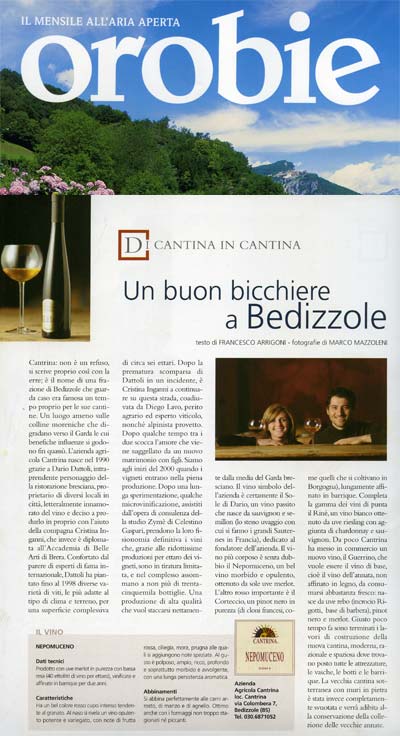
The monthly magazine Orobie dedicates an article to Azienda Agricola Cantrina, here are the most significant points: A good glass in Bedizzole (...) Cantrina: this is not a misprint, it is spelt just like that with an 'r'; it is the name of a hamlet of Bedizzole that, as chance would have it, was once famous precisely for its wine cellars. A pleasant place on the morainic hills sloping down towards Lake Garda, whose beneficial influences can be enjoyed right up here. The Cantrina winery was founded in 1990 thanks to Dario Dattoli, an enterprising character in the Brescian restaurant industry, owner of several establishments in the city, who literally fell in love with wine and decided to produce it himself with the help of his partner Cristina Inganni, who on the other hand graduated from the Brera Academy of Fine Arts. Supported by the advice of internationally renowned experts, Dattoli planted different varieties of vines, the most suitable for the type of climate and soil, on a total area of around six hectares until 1998. After Dattoli's untimely death in an accident, it was Cristina Inganni who continued along this path, assisted by Diego Lavo, an agricultural expert and wine expert, as well as an experienced mountaineer. (...) (...) After a long period of experimentation, some microvinification, assisted by the consultancy work of Celestino Gaspari's Zymè studio, the wines take their final shape. Thanks to the very low yields per hectare of the vineyards, they are in limited production, and in total amount to no more than thirty-five thousand bottles. This is a high quality production that is intended to stand out clearly from the average Brescian Carda. The company's flagship wine is certainly Sole di Dario, a passito wine made from Sauvignon and Semillon (the same blend used to make the great Sauternes in France), dedicated to the company's founder. The most full-bodied wine is undoubtedly Nepomuceno, a beautiful, soft and opulent wine made only from merlot grapes. The other important red is Corteccio, a pure Pinot Noir (from French clones, like those grown in Burgundy), aged for a long time in barriques. Completing the range of top wines is Riné, a white wine made from riesling grapes with the addition of chardonnay and sauvignon. Cantrina has recently released a new wine, Guerrino, which is intended to be the base wine, i.e. the wine of the year, not aged in wood, to be consumed fairly fresh: it is made from rebo grapes (Rigotti crossbreed, barbera base), pinot noir and merlot. Just recently, construction work was completed on the new, modern, rational and spacious cellar where all the equipment, tanks, barrels and barriques are located. The old underground cellar with stone walls, on the other hand, has been completely emptied and will be used to store the collection of old vintages.

Free Exercise in Style - Environment Europe

posted on 12 March 2009
Cantrina is a small hamlet in the Valtènesi valley that gives its name to the small winery where Cristina Inganni and Diego Lavo work in the vineyard and cellar. They are convinced that wine must express personality, uniqueness and be able to speak of its territory of origin. The soils on which the winery is located yield structured wines with good alcohol content, good minerality and high acidity. Long-lived wines that are born with natural respect for the interaction between soil and vineyard. (...)

Cristina Inganni - Lands

posted on 1 March 2009
THE STYLE OF AN ENTREPRENEUR IN THE WINE INDUSTRY, WHO DOES NOT FOLLOW THE RULES OF THE MARKET, BUT PRODUCES WHAT SHE LIKES BEST, RELYING ON HER OWN ABILITIES. It is easy to fall into banality or rhetoric. A woman entrepreneur, a woman who “makes” wine, and give rise to a whole series of clichés, even if ennobled by the best of intentions. The antidote, however, is just as easy to find: it is enough to listen to Cristina Inganni as she talks about her projects, so that one focuses on the substance, forgetting formalism. In a phase of Italian viticulture in which the search for indigenous grape varieties is almost exploding, her choices seem, at first glance, to go against the tide: she achieves great results with Sauvignon, Semillon, Chardonnay, Merlot, Pinot Noir, Riesling ... But the answer is immediate: “In my opinion, it is easier to identify the “terroir”, the identity of the territory, in international vines,“ as happens with people who come from distant countries to places that, little by little, transform them, adding, modifying traits and ways until they become something unique, hybrids charged with a singular charm. And consideration does not clash with typicality, indeed “native vines are a heritage, a heritage to be protected”, but it is from confrontation, from the plurality of choices that we can enrich the world of wine.

Proudly Italian Bordeaux - Giornale di Brescia

posted on 29 November 2008
And the Brescians? Few but they were there and they did not disfigure at all. The rather scattered presentation of wines did not allow us to find them all. Presenting their products, however, were Cristina Inganni with her award-winning Nepomuceno and Giovanna Prandini with the brand new Leonatus. Both are pure Merlot. Fratelli Berlucchi, represented by oenologist Casare Ferrari, was there with Casa delle colonne (where the Cabernet is only Franc), but next to it we found a Deressi from Majolini that has boundless elegance and a Nero d'Ombra from Mirabella that is just as elegant, but far too austere. The wineries produce very little of it and therefore speak little of it. A little more is Barone Pizzini's San Carlo while again very little is San Giovanni's Cabernet Montezalto.
1 … 14 15 16 17 18 … 22