16 February 2005
Cantrina: outpost of tradition - Brescia Oggi
Bresciaoggi describes Azienda Agricola Cantrina in an article, here are the most important points:
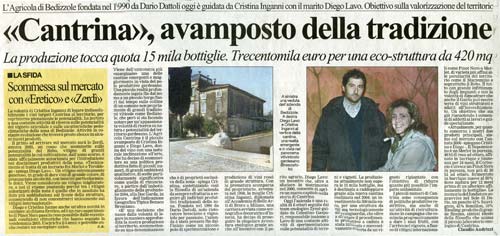
Cantrina - outpost of tradition
Production reaches 15 thousand bottles. Three hundred thousand euro for a 420sqm eco-structure.
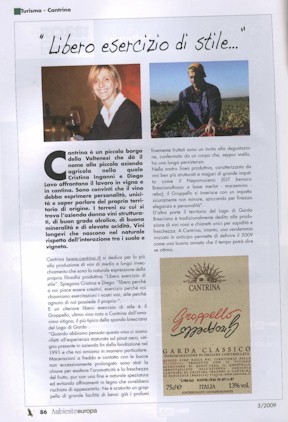
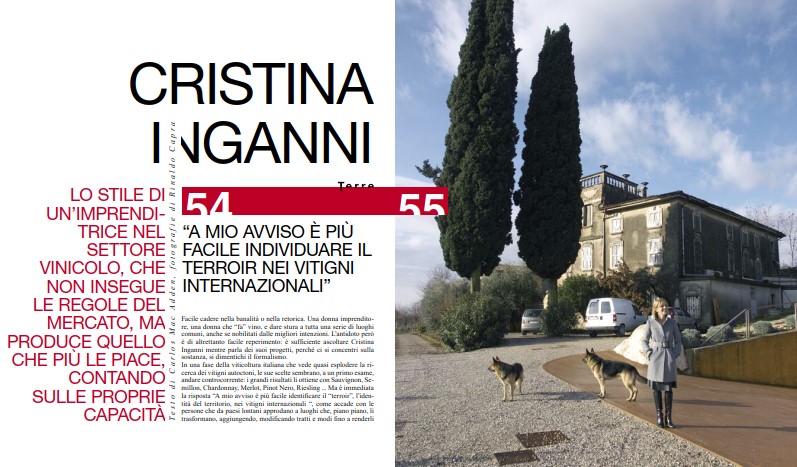
(...) Agricola Cantrina is the small outpost of Cristina Inganni and Diego Lavo, a woman of wine with a natural inclination towards art, who has decided to bet on a production policy made up of small numbers, great qualitative ambitions, and particularly significant choices such as that of renouncing, starting with the bottling of the 2004 production, the Garda DOC in favour of the Benaco Bresciano Typical Geographical Indication. «It is a decision that stems from the desire to link our production in depth to the territory, betting on a denomination that is the exclusive property of the area,« explains Cristina, summarising the philosophy of a company that has always been reluctant to follow the traditional production guidelines of the area. Founded in 1990 by Dario Dattoli, a well-known Brescian restaurateur and winemaker by passion, the winery was conceived from the outset as a small centre for experimentation and the production of well-structured red wines. With the untimely death of the owner in 1998, his wife Cristina Inganni, a graduate of the Brera Academy of Fine Arts in Milan, a career that began as a set designer and interior decorator, decided to continue the singular oenological adventure, thanks also to her meeting with the agrarian expert, Diego Lavo: an encounter that not only resulted in marriage in 2000, but also opened a new chapter in the history of Cantrina. (...)
Cristina Inganni's desire to indissolubly link Cantrina wines to the territory, in order to express their full potential, has led to constant research into the potential of the estate's vineyard and the pedo-climatic characteristics of the Bedizzole area, a constantly evolving activity that will soon result in some new products. The first to arrive on the market will be Zerdi, vintage 2003, a red wine that bets on the potential of Rebo, a vine with great potential whose cultivation was officially authorised last year for inclusion in the area's production specifications. »Technically, it is a cross between Merlot and Teroldego, explains Diego Lavo. It is an extremely generous vine, capable of giving wines of great colour, pronounced alcohol content and particularly sweet tannins. It is considered an improving vine, and we are focusing on it because among the authorised vines in the area, it is the one that has given the most satisfaction in terms of structure, allowing us not to concentrate solely on international varieties'. Diego and Cristina also have another novelty in the pipeline: it is called Eretico, and is a rare experiment in Pinot Noir raisin wine made possible by the exceptional climatic conditions that marked the 2003 harvest. It will be released in 2-3 years: and it might even remain a unique specimen.